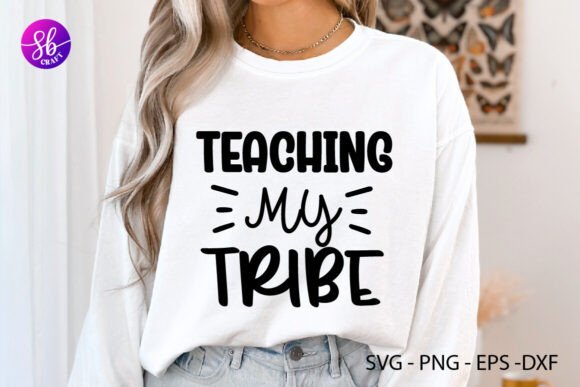
Teaching My Tribe Teacher SVG Design
A Designer’s First Look: Warm, Welcoming—But Does It Stitch Clean?
When I opened Teaching My Tribe Teacher SVG Design for the first time, I didn’t see just another back-to-school graphic—I saw a mood. Soft curves, balanced negative space, and that gentle, inclusive phrasing (“My Tribe”) immediately suggested warmth over flashiness. As someone who regularly translates digital files into stitched reality, my first question wasn’t “Is it pretty?” but “Will it hold up on a cotton tote bag after five washes? Will it read clearly at 3.5 inches wide on a baby onesie?” The answer depends less on aesthetics and more on construction—and this design leans into legibility and emotional resonance over ornate detail.
Real Project Test: Embroidering a Teacher Appreciation Tote Bag
Last week, I prepped a natural canvas tote for a local elementary school’s end-of-year gift drive—custom embroidered with Teaching My Tribe Teacher SVG Design. Not as a Cricut cut file (though it’s marketed that way), but as a converted machine embroidery design. I resized it to 4.25″ wide, centered it on the front panel, and chose a matte cotton thread in deep navy against unbleached fabric. The result? Crisp lettering, no crowding in the “i” dot or “y” tail, and smooth satin-stitched outlines that didn’t pucker. That’s rare for text-dominant designs—especially when the phrase includes subtle kerning and a slightly rounded font. It felt handmade, not mass-produced. Customers noticed. One teacher held hers up and said, “It doesn’t scream ‘teacher gift’—it feels like something I’d choose for myself.” That’s the quiet power of this design: it supports the wearer’s identity instead of labeling it.
Where It Shines—and Where It Needs Care
Teaching My Tribe Teacher SVG Design works beautifully across several embroidery project types—but not all equally:
- Custom apparel: Excellent on sweatshirts and crewneck tees—its moderate width and open letterforms avoid dense fill stitch traps.
- Embroidered patch: Clean edges translate well to twill or felt backing; minimal underlay needed.
- Baby embroidery: Scales down reliably to 2.75″ without losing clarity—ideal for bibs or onesies, provided you use lightweight stabilizer.
- Holiday embroidery & personalized gifts: Fits naturally into teacher appreciation bundles (think mugs + towels + embroidered pillow covers) because its tone is timeless—not tied to a single season.
- Small shop product: Reads well in boutique settings where customers value intentionality over trend-chasing.
But caution is warranted for:
- Curved surfaces like caps—tighter hoops and stretchy fabric demand simplified versions or re-digitized outlines; the original SVG may need adaptation.
- Textured fabrics (terry cloth, heavy linen): Letter spacing can visually close up unless stitch density is reduced and stabilizer is upgraded.
- Dark fabric: The design’s light-weight lines benefit from underlay or shadow fill—don’t assume default settings will deliver crisp contrast.
- Frequent-wash items (kitchen towels, baby blankets): Test stitch density—overly dense fills may stiffen fabric or encourage thread breakage over time.
What This Design Says About Your Brand—Before a Single Stitch
Using Teaching My Tribe Teacher SVG Design isn’t just about adding text to fabric—it’s signaling values. It tells customers your craft business prioritizes connection over cliché, care over convenience. That builds trust faster than any “handmade with love” tagline. For Etsy sellers, it elevates perceived value: buyers don’t just purchase a teacher shirt—they invest in a sentiment they recognize and want to wear proudly. For small shop owners curating nursery decor or holiday gift sets, it adds cohesion without repetition. And for embroidery designers building digital embroidery file libraries, it’s a versatile anchor piece—equally effective as a standalone motif or layered beneath a simple floral applique design.
Practical Notes Every Embroidery Designer Should Check
Before stitching—or listing this as part of your craft business inventory—run through these real-world checks:
- Test on scrap fabric first—especially if using textured, stretchy, or dark material.
- Review stitch density: If converting from SVG, confirm fill areas aren’t over-embroidered (look for >12,000 stitches in a 4″ design—that’s a red flag).
- Confirm hoop size compatibility: Does your intended placement fit comfortably within your most-used hoop? Don’t force tight corners.
- Inspect small details: Zoom in on the “g” loop and “r” leg—do they convert cleanly to satin or running stitch?
- Check thread color contrast on both light and dark backgrounds using printable mockups—not just screen previews.
- Use proper stabilizer: Medium-weight cutaway for knits, tear-away for stable wovens, and optional topping for napped fabrics.
- Verify licensing: Since this is sold as a Graphics product for Crafts, confirm whether commercial use (e.g., selling finished embroidered sweatshirts or digital embroidery files) is permitted—don’t assume.
Final Thought: A Quiet Design With Real Weight
Teaching My Tribe Teacher SVG Design won’t dominate a craft fair table with glitter or motion—but it will linger in memory. It’s the kind of design that earns repeat orders from teachers who’ve worn their first tote until the seams frayed, then came back for an apron version. It works because it respects the craft: no unnecessary flourishes, no fragile details, no visual noise. Just clear intent, thoughtful spacing, and quiet confidence. For embroidery designers, Etsy sellers, and small shop owners building meaningful handmade products, that’s not just practical—it’s professional.